| 1. Technical Selection and Load Performance |
| Relevant European load standard | Commonly specified and tested to EN 124-2 for cast iron products. | Commonly specified and tested to EN 124-2 for ductile iron products. | Must be assessed against the applicable EN 124 product category and manufacturer test documentation. | Must be assessed against the applicable EN 124 category and product-specific test documentation. | Request a certificate or test report identifying the exact product, load class, test method, and manufacturing site. |
| Typical EN 124 load classes | A15: 15 kN; B125: 125 kN; C250: 250 kN; D400: 400 kN; E600: 600 kN; F900: 900 kN. Select the class according to the actual installation location, not only the nominal traffic level. | For roads and vehicle areas, D400 is frequently considered; the designer must confirm the required class from local regulations and site conditions. |
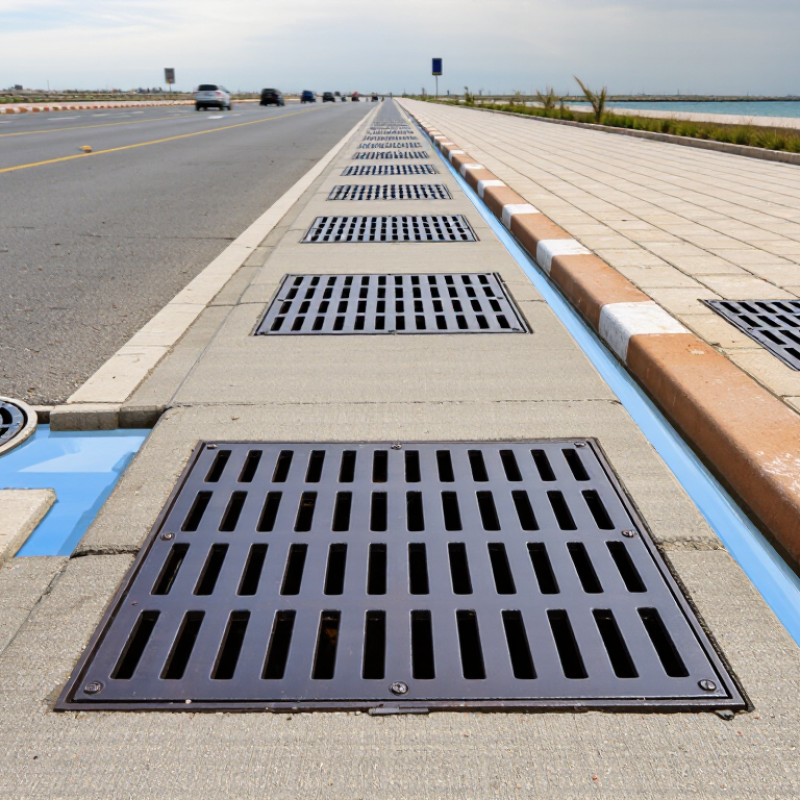
| Typical application zones | Footways, access areas, drainage channels, roads, and industrial yards. | Road carriageways, logistics yards, ports, airports, and heavy-duty industrial areas. | Corrosive, hygienic, architectural, coastal, and chemically exposed environments. | Corrosion-sensitive areas, pedestrian zones, drainage channels, and projects requiring lower handling weight. | Map the grate location to the applicable EN 124 installation zone: pedestrian, kerbside, carriageway, hard shoulder, or special high-load area. |
| Impact and fatigue resistance | High when correctly supported by the surrounding pavement. | Very high, with good resistance to impact and repeated traffic loading. | Depends on grade and design; verify deformation and fatigue data. | Product-dependent; confirm long-term load and impact testing. | Review both laboratory load results and the support detail beneath the frame; poor bedding can cause failure even with a high-rated grate. |
| Corrosion resistance | Moderate; surface oxidation is common, especially in wet or saline conditions. | Moderate to good; coatings and drainage design can improve service life. | Very good when the stainless grade matches the chloride and chemical exposure. | Very good because the material is not subject to conventional iron corrosion. | Consider chloride concentration, de-icing salts, wastewater chemistry, humidity, and stray-current exposure. |
| Noise and movement control | May generate rattling if the cover, frame, or locking system is not accurately fitted. | Can provide good performance with elastomeric seating, precision machining, and a locking mechanism. | Can provide low noise when supplied with a suitable seating insert and anti-movement detail. | Often provides low handling noise, but the frame-to-pavement interface remains critical. | Specify a tested anti-rattle system, cover restraint, seating material, and allowable movement tolerance. |
| Approximate handling weight | Often heavy; large covers may require lifting equipment or a multi-part design. | Generally lighter than an equivalent grey cast iron design, but still substantial at D400 sizes. | Usually lighter than iron for comparable openings, but weight varies significantly with construction. | Often lighter than iron products; confirm actual unit weight and manual-handling limits. | Obtain the exact cover and frame weights. Plan lifting points or lifting keys where manual removal is not appropriate. |
| 2. Supplier Comparison Criteria |
| Technical documentation | Require dimensional drawings, material specification, load-class evidence, coating details, and installation instructions. | Require the same documents plus ductile iron grade and production quality records. | Require stainless grade, surface finish, weld or fabrication quality information, and chemical-resistance data. | Require resin or composite formulation range, reinforcement details, load testing, and UV or chemical-resistance data. | Do not compare quotations using price alone; compare identical dimensions, clear openings, load class, locking system, and frame design. |
| Quality verification | Check foundry process controls, dimensional inspection, coating inspection, and traceability. | Check casting quality, nodularity or material records where applicable, dimensional control, and traceability. | Check material certificates, weld quality, finish consistency, and dimensional inspection. | Check batch traceability, curing control, dimensional stability, and independent performance testing. | Request a sample inspection plan and clarify who pays for third-party testing before mass production. |
| Manufacturing location and logistics | Transport cost, pallet density, port handling, customs classification, packaging, and local stock can materially change the delivered cost. | Compare total delivered cost to site, lead time, spare-part availability, and the supplier's ability to support multiple project countries. |
| Customization capability | Common options include dimensions, frame depth, cover pattern, hinge, lock, and coating. | Common options include dimensions, load class, locking system, hinge, lifting key, and coating. | Common options include grade, finish, perforation pattern, frame design, and architectural surface treatment. | Common options include dimensions, color, surface texture, opening pattern, and frame configuration. | Confirm that customization does not invalidate the tested load configuration or product certification. |
| Supplier service rating | ★★★★☆ for widely available standard formats. | ★★★★☆ for infrastructure and heavy-duty requirements. | ★★★☆☆ for specialist or architectural requirements. | ★★★☆☆ where regional availability and technical support may vary. | Use a weighted score: compliance 30%, technical performance 25%, delivered cost 20%, lead time 10%, warranty and service 15%. |
| 3. Installation Method and Site Execution |
| Frame support | The frame should be continuously and evenly supported by an approved bedding or surround system. Avoid point loading, voids, and unsupported frame edges. | Follow the project engineer's detail and the product installation instructions; the pavement surround is part of the load-bearing system. |
| Recommended bedding approach | Use a compatible high-strength, shrinkage-controlled bedding or concrete surround selected for the traffic class, curing time, temperature, and site conditions. | Confirm compressive strength, working time, curing requirements, minimum surround depth, and compatibility with the road construction sequence. |
| Level and alignment | Set the frame flush with the final pavement surface and maintain the correct slope and orientation. Avoid raising the cover above the surrounding surface. | Use surveying equipment or a calibrated straightedge; check finished levels after compaction and before opening to traffic. |
| Traffic opening | Opening time depends on the bedding material, ambient temperature, moisture, curing conditions, and achieved strength—not merely elapsed hours. | Obtain the installer or material supplier's written minimum strength and traffic-opening requirement. |
| Maintenance access | Use lifting keys and plan for potential corrosion or accumulated debris around the frame. | Use lifting keys, hinges, or locking systems appropriate for repeated maintenance access. | Protect finished surfaces from impact and use compatible tools to avoid scratching or galling. | Use manufacturer-approved lifting tools and avoid levering against brittle edges. | Include safe access procedures, confined-space controls, replacement parts, and cleaning frequency in the maintenance plan. |
| 4. Indicative Lifecycle Cost Comparison |
| Initial purchase cost | Low to medium for standard formats. | Medium, often higher than grey cast iron for equivalent standard products. | High, especially for corrosion-resistant grades and fabricated designs. | Medium; varies substantially by reinforcement, certification, and size. | Compare the same clear opening, external frame dimensions, load class, locking system, coating, and included accessories. |
| Installation cost | Medium to high if heavy lifting equipment or traffic management is required. | Medium; weight reduction may simplify handling in some sizes. | Low to medium for lighter units, subject to specialist fabrication and protection requirements. | Low to medium where manual handling is permitted and the installation detail is simple. | Include labor, lifting equipment, temporary traffic control, bedding material, curing time, and pavement reinstatement. |
| Routine maintenance cost | Medium; inspect corrosion, seating, frame condition, and rattling. | Low to medium when the coating and seating remain intact. | Low in suitable exposure conditions, although cleaning may be needed for appearance or hygiene. | Low in corrosion-sensitive locations; inspect for impact damage and edge wear. | Base the estimate on local labor rates, inspection intervals, cleaning requirements, and replacement-part availability. |
| Expected service-life planning | Highly dependent on traffic, drainage, corrosion, coating, bedding quality, and maintenance. | Highly dependent on traffic, corrosion protection, frame support, and maintenance. | Highly dependent on stainless grade, chloride exposure, crevice design, and cleaning. | Highly dependent on resin system, UV exposure, chemical environment, impact, and tested load performance. | Use a project-specific service-life model; do not apply a single universal lifespan to all materials or locations. |
| Replacement risk | Moderate; increased by theft, corrosion, poor seating, and repeated impact. | Low to moderate; locking and anti-theft features can reduce unauthorized removal. | Low for corrosion-related replacement when correctly specified. | Moderate; assess vulnerability to impact, fire, UV, and inappropriate tools. | Include the cost of replacement, traffic disruption, emergency call-outs, and inventory of critical spare units. |
| Lifecycle-cost formula | Lifecycle cost = purchase price + delivery + installation + inspections + cleaning + repairs + replacement allowance + traffic-management cost − residual value. | Use a common study period, such as 25 or 30 years, and discount future costs using the owner's approved financial method. |
| 5. Final Selection Guidance |
| Best fit for standard urban roads | Often suitable when the required EN 124 class, frame support, anti-rattle detail, and corrosion protection are properly specified. | Usually selected only when corrosion, hygiene, or architectural requirements justify the higher cost. | Suitable only where the product has verified performance for the required traffic and environmental conditions. | Prioritize verified load performance, stable seating, local availability, and maintainability. |
| Best fit for coastal or chemically aggressive sites | Use with protection and inspection. | Use with suitable coating and inspection. | Often suitable when the stainless grade is correctly matched to exposure. | Often suitable if chemical and load testing supports the application. | Require a written exposure assessment covering chlorides, wastewater chemistry, de-icing salts, and cleaning agents. |
| Best fit where manual handling is important | Limited for large units. | Possible with suitable size and lifting design. | Often favorable. | Often favorable. | Confirm unit weight, safe lifting method, ergonomic requirements, and local occupational-safety rules. |
| Minimum procurement checklist | Specify clear opening; frame dimensions; EN 124 load class; installation zone; material and coating; cover weight; locking or hinge system; anti-rattle detail; drainage arrangement; test documentation; warranty; spare-parts availability; delivery terms; and installation responsibility. |